Garage Door Service for Foxfield's 1980s-Built Homes
Foxfield homes date to around 1982, which means specific spring and opener issues. Go Denver Garage Door travels from Denver to handle them, no local depot claimed.
Foxfield's houses cluster tight around 1982, which puts it right in the middle of the wider Denver-area build window of 1947 to 2006. That single-decade concentration matters more than it sounds like it should. A neighborhood built over sixty years has a mess of door types, but a small area like this one, with roughly 276 households, mostly went up within a few years of each other. That means the doors, the openers, and the failure points repeat from driveway to driveway. Builders in this era were moving away from wood panel doors and into steel, and garage door openers were becoming standard equipment rather than an add-on. The torsion spring setups from that period were built for the doors of the day - lighter, less insulated than what's sold now. Forty-plus years on, those original springs are long past due, and a fair number of houses here are still running openers from a second or third replacement cycle, not the original unit. Knowing the build year up front changes what a technician expects to find before the truck even pulls into the driveway.
How That Shows Up in the Door
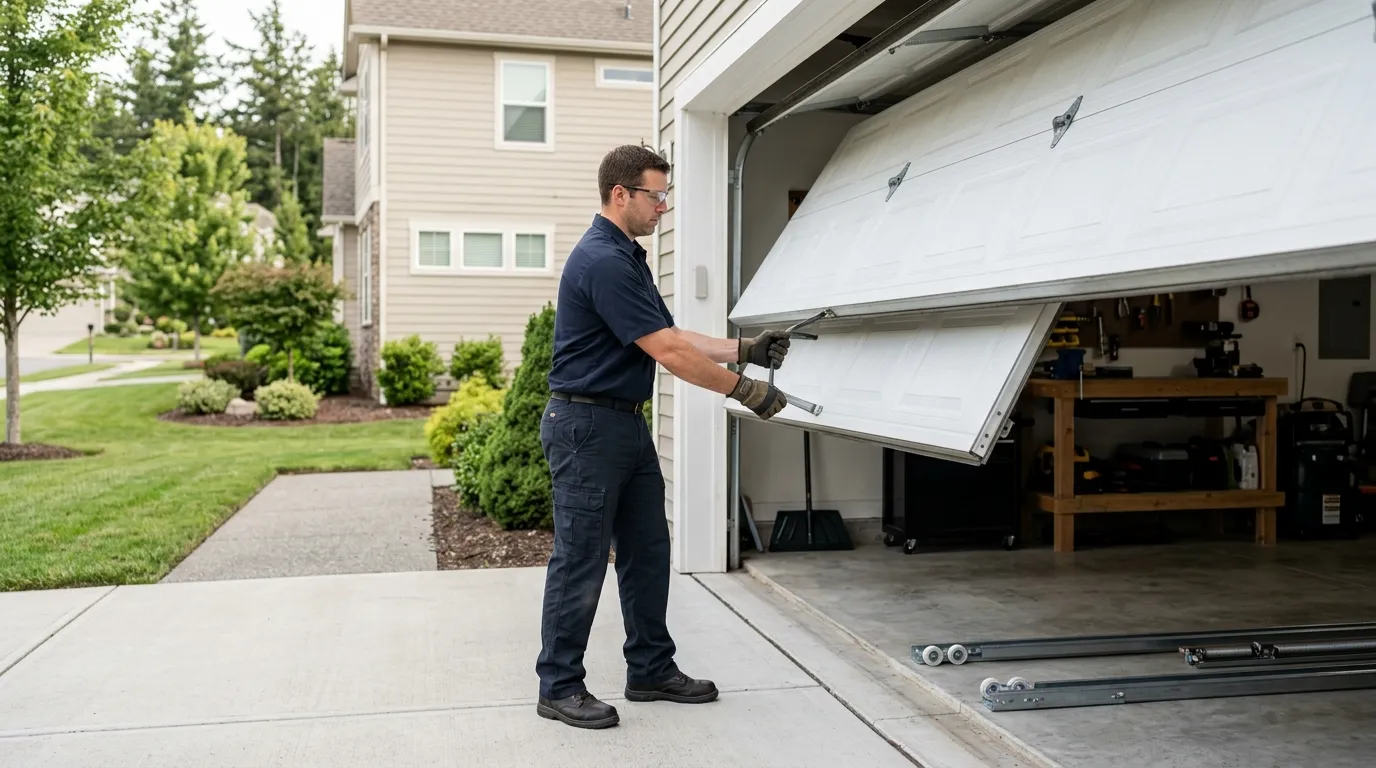
A door hung in the early 1980s was almost certainly a single steel layer with no foam core, on side-mounted torsion hardware sized for that lighter panel. If a homeowner has since swapped in a heavier insulated door - and at a median household income of $195,750, plenty of owners here have upgraded to better doors - the original spring is often still doing the lifting. That's an undersized spring fighting an oversized door, and it shows up as an opener straining, a door that won't stay put halfway, or a spring giving out years before it should. Cold makes it worse. This area sits in a climate band the federal data marks as severe cold, and steel contracts, grease stiffens, and springs that are already borderline get pushed past their limit on the coldest mornings. None of this is exotic - it's just what happens to 1982-era hardware carrying 2020s doors through Colorado winters. The fix is usually a spring re-sized to the actual door weight, not a patch on the old one.
Getting Here
Foxfield sits about 13 miles out from Go Denver Garage Door's base in Denver. The company doesn't keep a depot or a crew stationed in Foxfield itself - every job here means a truck routed out from the city, same as it would for Cherry Hills Village at 9 miles or Stonegate at 16. That's worth saying plainly: this is a service area covered from Denver, not a local shop with someone already down the street. What it does mean is a technician who's worked the same building era across a large stretch of the metro - Foxfield's 1982 stock isn't unusual to a crew that also covers Meridian and Grand View Estates, both built in a similar window. The tradeoff is honest: a same-day slot depends on the day's route, not on proximity, since nobody's parked around the corner waiting.
Older vs Newer Streets
Even within a small area like Foxfield, houses split into two rough camps: those still running original or first-replacement hardware from the early 1980s, and those that have already been through a full door and opener swap. The tell is usually the spring type and the opener's drive - older setups tend to be extension springs over the tracks or an early torsion bar, paired with a chain-drive opener loud enough to hear from the street. Newer replacements lean toward torsion springs sized to code, belt-drive openers, and doors with actual insulation ratings. Across the wider service area, which covers 219,760 households and 96,547 owner-occupied houses, this pattern holds: age of the door usually tracks age of the house, unless someone's already replaced it. One limitation worth naming - a door from this era with rusted-through track or a bent panel usually isn't worth patching. Once the frame's out of square, a new spring won't fix what's actually a structural problem, and replacement ends up cheaper than repeated repair calls.
How it works
From “it’s stuck” to “it’s fixed”
01
Tell us what’s wrong
Describe the symptom - won’t open, loud bang, opener runs but the door won’t move.
02
On-site diagnosis
A technician tests the door under power and by hand and finds what actually failed.
03
Clear, up-front plan
You get the fix that’s needed and what drives the cost - before any work starts.
04
Repaired & tested
The repair is done, the door is set true and tested, and the work area left clean.
Serving Denver, CO - tell us what your door’s doing and we’ll take it from there.
How old are most garage doors in Foxfield likely to be?
Housing here centers on 1982, so a lot of original doors and hardware are past 40 years old. Even where the door itself has been replaced, the original torsion spring sometimes stays in place under a heavier new door, which is a common source of strain and premature failure.
Does Go Denver Garage Door have a crew based in Foxfield?
No. The company runs out of Denver, about 13 miles away, and routes trucks out to Foxfield and nearby areas as jobs come in. There's no local depot here, so scheduling depends on the day's route rather than someone already being nearby.
Why do springs seem to fail more in winter here?
This area falls in a severe cold climate band. Cold stiffens grease and contracts steel, which pushes a spring that's already near the end of its life over the edge. It's not a coincidence that a lot of spring failures land on the coldest mornings of the year.
Is it worth repairing a door from the early 1980s?
Sometimes. If the track and frame are still square, a re-sized spring and a serviced opener can carry a door for years. If the track is rusted through or the frame's out of square, repeated repairs usually cost more over time than replacing the door.
Ready to get your garage door sorted?
Tell us what it’s doing and where you are in Denver - we’ll take it from there.