Garage Door Repair for Glendale's 1980s Housing Stock
Glendale's houses mostly went up around 1983, five miles from Denver, meaning aging torsion springs and openers from that era still need real service work.
Glendale's garage doors are almost all original to the early 1980s build wave that put up most of this pocket, five miles from Denver. That means the sizing, spring type, and mounting hardware on your door were spec'd for houses that are now over forty years old, and what a job costs depends on whether you're matching worn parts to that original hardware, or doing a full opener swap because the drum or shaft is out of spec. We don't publish one flat number here because a straight spring or cable repair runs different money than a door-and-opener replacement, and what you actually need depends on what's on the house right now, not on the model year alone. What we can say: a spring or cable fix on hardware that's still sound usually costs less than replacing a door that's already been patched more than once. If an opener's been rewired or swapped more than once already, another repair often isn't worth it - replacing it usually is. See our Glendale service page for what we handle in this area, or the Denver service page for the full range of work we do across the area.
Why This Fails Locally
Across the wider Denver service area, houses went up anywhere from 1947 to 2006, with a heavy share of that stock landing in the 1980s and 90s. Glendale sits right inside that window - most of its 2,678 households are in homes built around 1983, tight enough that the hardware doesn't vary much block to block. Doors from that build year were mostly steel panel with extension springs mounted along the horizontal track, not the torsion setup over the header that's standard on newer builds. That hardware wasn't engineered for the cold-band swings this part of Colorado gets - the coating on 40-year-old extension springs work-hardens over time, and enough freeze-thaw cycles make them snap sooner than they would in a milder climate. It's also why we see more broken extension springs here than snapped torsion springs: the parts are older, and fewer of them are carrying the same weight. None of it is dramatic. It's just what happens when a build year and a hard winter climate line up the same way, year after year, on the same doors.
What the Repair Takes
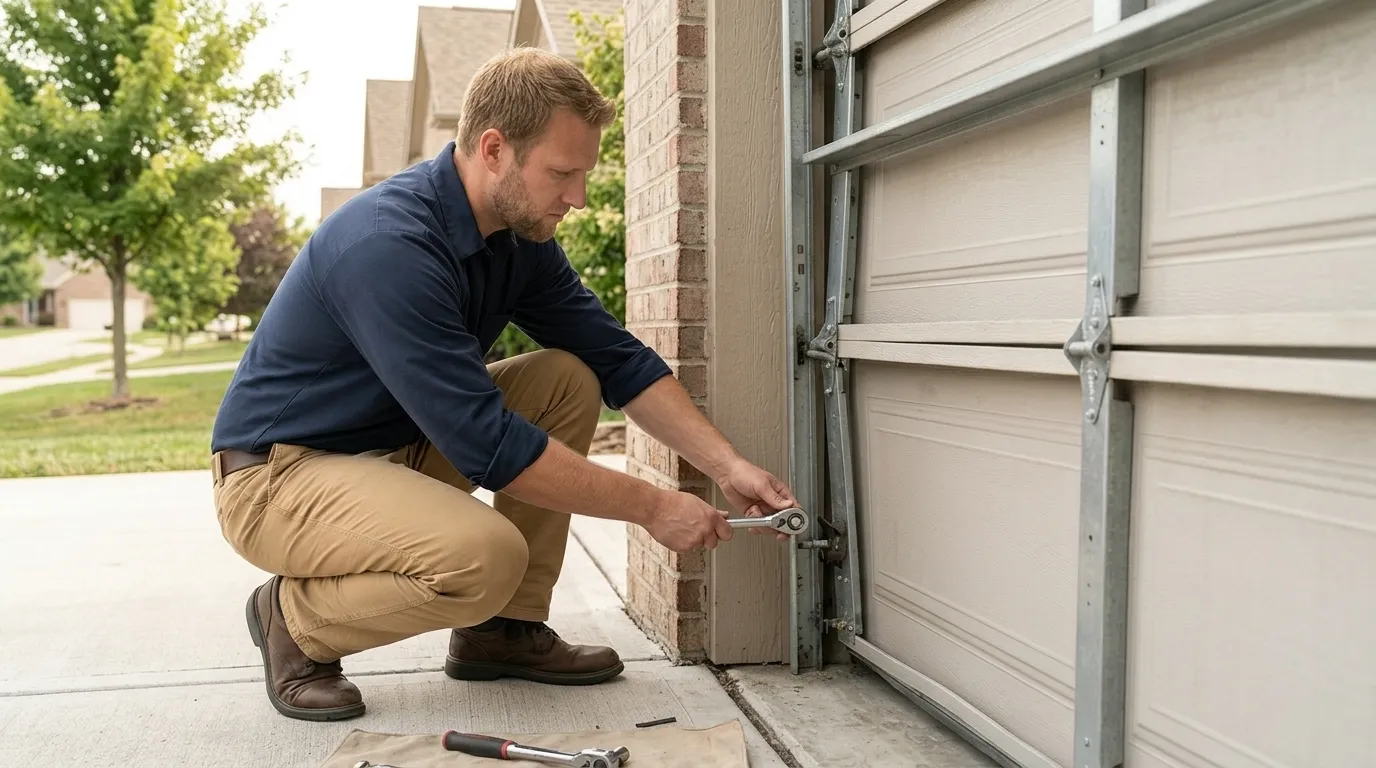
Most calls in Glendale start the same way: a spring gave out on original hardware, or the opener - likely the second or third one on that door since 1983 - finally quit. If it's a spring, we match wire gauge and length to what's already mounted, since extension springs from this era aren't a single universal part. We carry common sizes on the truck, but a less common gauge can mean a short wait on the part rather than a same-visit fix - that's the honest limit of working on hardware this old from a truck that comes five miles out of Denver. If it's the opener, the work is usually a full swap rather than a repair, because patching electronics built for forty-year-old door hardware rarely holds for long. Either way, we check the track brackets and drum for wear before we touch a spring, because on a door this age, swapping the spring without checking the rest of the hardware just moves the next failure a few months down the road instead of fixing it.
Where This Job Goes Sideways
The real trouble spot on 1983-era doors in Glendale is usually the drum or the track brackets, not the spring everyone calls about. Forty years of expansion and contraction loosens brackets that were fine when the house was new, and a fresh spring bolted onto a loose bracket fails again inside a year. We also see doors where an earlier repair mixed spring types - an original extension spring on one side, a mismatched replacement on the other - which throws the door's balance off and wears the opener gears faster than it should. Given the median household income here runs well below the wider service area's $101,450, most homeowners in Glendale want the repair that actually lasts, not one that gets patched again in six months, so we'd rather flag a bracket or track problem now than sell a spring job that fails again shortly after. The job also goes sideways when the door panel itself, not just the hardware, has warped from four decades of Colorado winters - at that point a new door is the honest recommendation, not another spring.
How it works
From “it’s stuck” to “it’s fixed”
01
Tell us what’s wrong
Describe the symptom - won’t open, loud bang, opener runs but the door won’t move.
02
On-site diagnosis
A technician tests the door under power and by hand and finds what actually failed.
03
Clear, up-front plan
You get the fix that’s needed and what drives the cost - before any work starts.
04
Repaired & tested
The repair is done, the door is set true and tested, and the work area left clean.
Serving Denver, CO - tell us what your door’s doing and we’ll take it from there.
Why does my Glendale house need a different spring setup than a newer house nearby?
Most homes in Glendale went up around 1983, when extension springs mounted along the horizontal track were standard. Newer builds elsewhere in the area typically use torsion springs over the header. The two systems aren't interchangeable, and matching the original setup matters more than just buying whatever spring is on the shelf.
Do you have a shop or depot in Glendale?
No. We work out of Denver and travel the five miles into Glendale for jobs. We don't keep a local branch here, so we're not able to promise a same-hour arrival - we schedule the trip like any other call in the service area.
How old is too old for a garage door opener?
There's no fixed number, but an opener that's been rewired or repaired more than once, especially on a door original to a 1980s build, is usually past the point where another patch makes sense. At that stage a full swap tends to cost less over time than repeated repair visits.
Why did my spring snap in the middle of winter?
Extension springs from the early 1980s go through decades of freeze-thaw cycles in this climate band, which work-hardens the steel and makes it more likely to snap under cold-weather tension than it would in a milder region. Age plus cold is usually the combination, not one or the other alone.
Ready to get your garage door sorted?
Tell us what it’s doing and where you are in Denver - we’ll take it from there.